Why Your Knee Feels “Loose” Going Downhill or Down Stairs — And What to Do About It
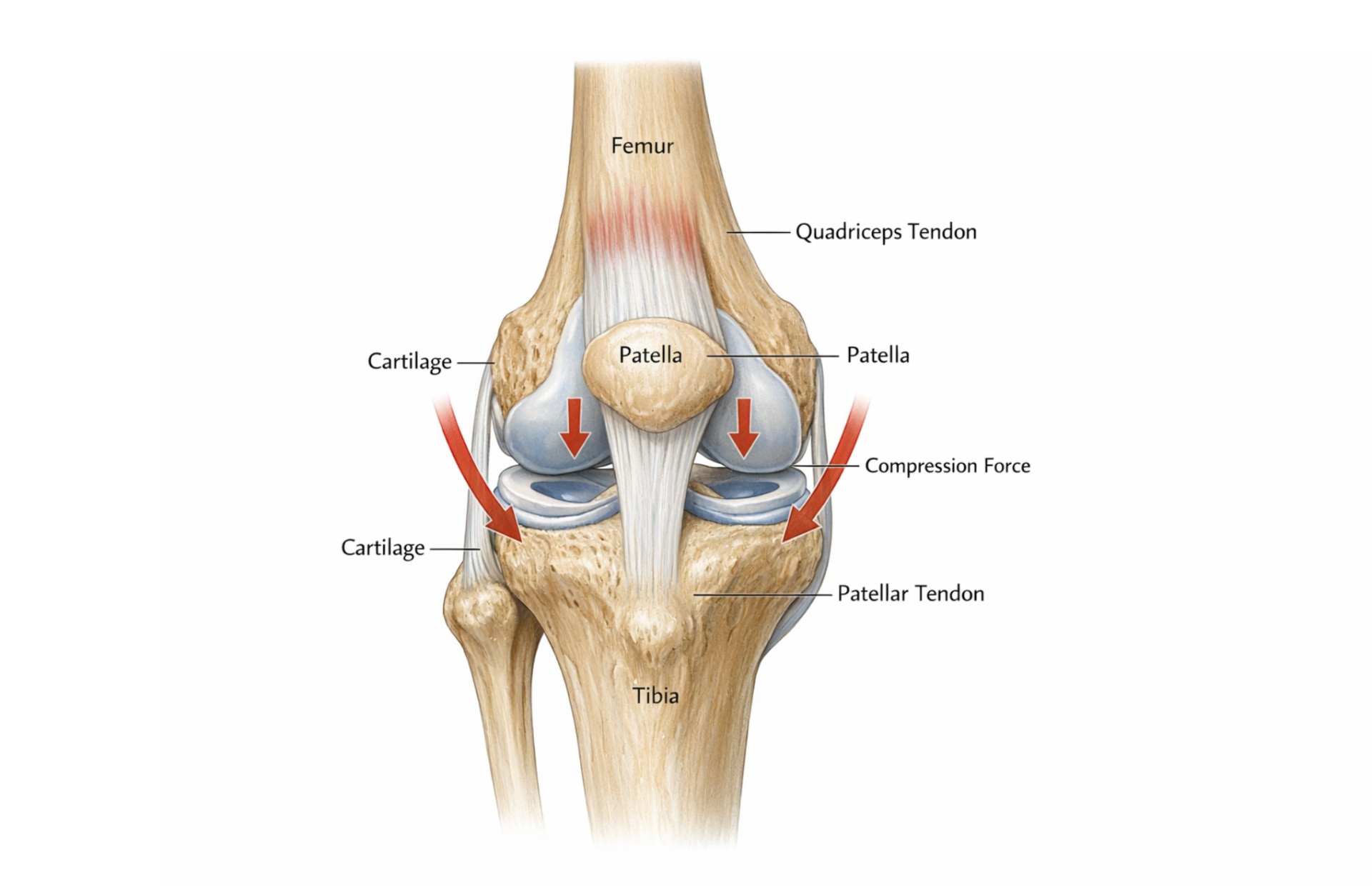
Many active people describe the same unnerving feeling: the knee doesn't always hurt, but it feels wobbly, “loose,” or like it might give way when walking downhill or stepping down stairs. That sensation can be scary — especially if you're busy, training, or simply trying to stay independent and confident.
In many cases, this isn't a sign that your knee is “done” or permanently damaged. It's often a mismatch between how much control the task demands and how prepared your muscles and nervous system are for that exact demand.
Why downhill and stairs feel so demanding
Descending is basically controlled falling. Your body has to absorb your weight while lowering on a bent knee — and your quadriceps (front‑thigh muscles) act like brakes, lengthening under tension (eccentric work) to control the drop.
That combination — bent knee + body weight + eccentric braking — can create high stress through the kneecap (patellofemoral joint) and require excellent coordination at the hip, knee, ankle, and foot. If you're even a little under‑trained, stiff, fatigued, or cautious, your knee may feel less “secure” during descent than during level walking or climbing up.
What the “loose” feeling usually means
People use the word “loose” to describe different things. Most commonly, it's one (or a mix) of these:
- Your quads aren't strong enough yet for controlled lowering — or they don't “switch on” fast enough.
- Your balance and joint position sense (proprioception) are a bit “blurry,” especially on uneven ground or small steps.
- The knee is irritated (patellofemoral pain, overuse, early arthritis), and your brain turns down muscle output to protect it.
- Old injuries (ACL/meniscus) changed mechanics or confidence, and descent exposes those weak links.
- Whole‑body factors: footwear, calf/ankle stiffness, fatigue, or fear of slipping.
When to get assessed first (don't “push through” these)
Book an in‑person assessment (sports medicine or physiotherapy) if you have:
- True buckling where the knee gives way and you nearly fall
- Large swelling after activity or a knee that looks noticeably bigger than the other side
- Locking/catching where the knee gets stuck and won't fully bend or straighten
- A clear twist/fall/impact followed by immediate instability
- Red, hot, very stiff joint, fever, or sudden severe pain without a clear reason
5 common contributors (and why they matter)
1) Quadriceps weakness or “brake” endurance
Your quads keep the knee centered and control how fast you lower. If they're underpowered or they fatigue quickly, the knee can feel shaky on the way down — even if you feel fine on flat ground.
Common clues: you prefer taking stairs sideways, you grip the railing hard, or one leg “drops” faster than the other.
2) Hip control (especially glute med)
The hip controls where your knee tracks. If the hip collapses inward, the knee often follows — which can feel unstable or “not stacked” when you step down.
3) Proprioception and balance (“joint GPS”)
Your knee relies on sensory feedback from ligaments, capsule, and muscles. Pain, swelling, prior injury, and time off can dull that signal. On stairs and slopes, small errors feel bigger — so your brain interprets it as instability.
4) Irritation under the kneecap or inside the joint
If the kneecap region or joint surfaces are irritated, your nervous system often inhibits muscle output (a protective reflex). That can create the odd combo of: “It's not terrible pain, but it doesn't feel trustworthy.”
5) Ankle mobility, calves, footwear, and fatigue
Limited ankle dorsiflexion, weak calves, or overly soft shoes can reduce control on descent. Also: fatigue (poor sleep, hard training block, long day) makes the brain more conservative — confidence drops and the knee feels “looser.”
The fix: 3 pillars that rebuild a confident knee
Most people improve fastest when they train three things in parallel: (1) downhill strength, (2) single‑leg control, and (3) graded exposure to the exact task that feels sketchy.
Pillar 1 — Build “downhill strength” (eccentric quads)
Pick 1–2 options and train them 2–4x/week:
- Slow step‑downs (best first choice): start with a 4–6 inch step, 2–3 sets of 6–10 reps/side. Lower for 3–5 seconds. Use light hand support.
- Sit‑to‑stand eccentrics: stand up normally, then lower back down slowly (3–5 seconds). 2–3 sets of 8–12.
- Seated knee extension slow‑lower (band or machine): lift with both legs if needed, lower with one leg over 3–5 seconds. 2–3 sets of 6–10.
- Wall sit or Spanish squat hold (isometric): 3–5 holds of 20–45 seconds. Great on “irritable” knees.
Pain guideline: mild discomfort is okay, but keep it ≤3–4/10 and make sure it settles within 24 hours.
Pillar 2 — Improve single‑leg control (hip + calf + foot)
Pick 2–3 and train them 2–3x/week:
- Banded side‑steps / monster walks: 2–3 sets of 10–15 steps each direction.
- Supported single‑leg RDL (hip hinge): 2–3 sets of 6–10/side. Keep hips level.
- Split squat (short range at first): 2–3 sets of 6–10/side. Progress range before load.
- Calf raises (off a step if tolerated): 2–3 sets of 10–15. Progress to single‑leg.
- Tibialis raises against a wall: 2–3 sets of 10–20.
Pillar 3 — Retrain balance & proprioception (the “knee GPS”)
2–5 minutes daily or 3–4x/week works well:
- Single‑leg stand near support: 3 x 20–40 seconds/side. Progress by head turns or eyes closed.
- Heel‑tap step‑downs: tap the free heel lightly, keep knee tracking over 2nd toe. 2 x 6–10/side.
- Star taps (clock reach): reach the free foot forward/side/back while standing on one leg, 2 rounds/side.
Technique tips that instantly make descent easier
- Use the railing at first — then use it less over time as control improves.
- Think “quiet steps.” A softer landing usually means better control.
- Slight forward lean from the hips (not leaning back) often feels more stable.
- Shorter steps reduce peak load. On steep hills, zig‑zag instead of going straight down.
- Keep the knee stacked over the middle toes (avoid collapsing inward).
- For hiking: consider trekking poles for a few weeks while strength catches up.
- Choose stable shoes on days the knee feels uncertain (very soft shoes can feel wobbly).
A simple 2‑week “confidence builder” example
If you want a straightforward starting plan, try this:
Week 1 (build control)
- Strength A (2x this week): slow step‑downs + banded side‑steps + calf raises
- Strength B (1–2x this week): wall sit (or Spanish squat) + split squat short range + tibialis raises
- Exposure (2–3x this week): one easy stair set or 3–5 minutes of gentle downhill walking; use railing/poles
Week 2 (progress a little)
- Increase step height slightly (or add 1–2 reps per set) on step‑downs
- Add 1 extra set to one strength move (not all of them)
- Exposure: add a second stair set OR +2 minutes of downhill volume
- Keep pain ≤3–4/10 and symptoms calm the next day
Bottom line
A “loose” feeling on stairs or downhill is often trainable. Downhill demands strong eccentric quads, steady hip control, and good balance on a small base of support. When you build those three pillars and re‑expose the body gradually, confidence usually returns.
If you're unsure where to start, or if you're seeing true buckling/swelling/locking, get assessed so you can load the knee safely.
Resources:
- Kolasinski SL, et al. 2019 ACR/Arthritis Foundation Guideline for the Management of Osteoarthritis of the Hand, Hip and Knee.
- Rice DA, McNair PJ. Mechanisms of quadriceps muscle weakness in knee joint osteoarthritis.
- Øiestad BE, et al. Knee extensor muscle weakness as a risk factor for knee osteoarthritis (systematic review/meta-analysis).
- Segal NA, et al. Quadriceps weakness and risk of knee joint space narrowing (longitudinal study).
- Knoop J, et al. Proprioception in knee osteoarthritis (review).
- Wang Y, et al. Proprioceptive training for knee osteoarthritis (systematic review/meta-analysis).
- Grenholm A, et al. Biomechanics considerations during stair descent and patellofemoral loading.