
Your Liver's Cholesterol Thermostat: What It Really Does (and What Actually Changes LDL)
Cholesterol is a waxy, fat-like substance your body needs to function. It’s a building block for every cell membrane, it helps your body make steroid hormones (like estrogen and testosterone), it’s used to produce vitamin D, and it’s required to form bile acids that help you digest and absorb fats. Because cholesterol doesn’t dissolve in blood, your body packages it into “lipoproteins” to move it around, most commonly LDL (which carries cholesterol to tissues) and HDL (which helps transport cholesterol back to the liver). Importantly, your liver and intestines help regulate supply, so cholesterol isn’t just something you “eat,” it’s something your body actively manages. Genetics can play an important role in how your body clears LDL particles, as familial hypercholesterolemia (FH) is an inherited condition.
In addition, the standard LDL-C lab value reflects the amount of cholesterol inside LDL, not necessarily how many LDL particles are circulating. Two people can have the same LDL-C but very different particle counts. Markers like apolipoprotein B (apoB) can clarify risk when LDL-C and the “real traffic” of particles don’t match. Many reviews and statements highlight apoB as a stronger risk marker than LDL-C. This is why cholesterol numbers can sometimes feel misleading without context.
Metabolic health matters here too. When triglycerides (TG) are low and fasting insulin/blood glucose are well controlled, that often suggests better insulin sensitivity and a less “atherogenic” lipid pattern overall. Many athletes and highly active people show lower TG and favorable HDL changes with training, yet can still see higher LDL-C depending on genetics, diet style, and energy balance. Also, our body tightly regulates it, so two people can eat similar foods and see different LDL (“bad cholesterol”) changes. Bottom line: a single LDL-C number doesn’t always tell the whole story; you need to go way deeper.
For these reasons, cholesterol remains a confusing and questionable subject for patients and even cardiologists.
The “thermostat” idea
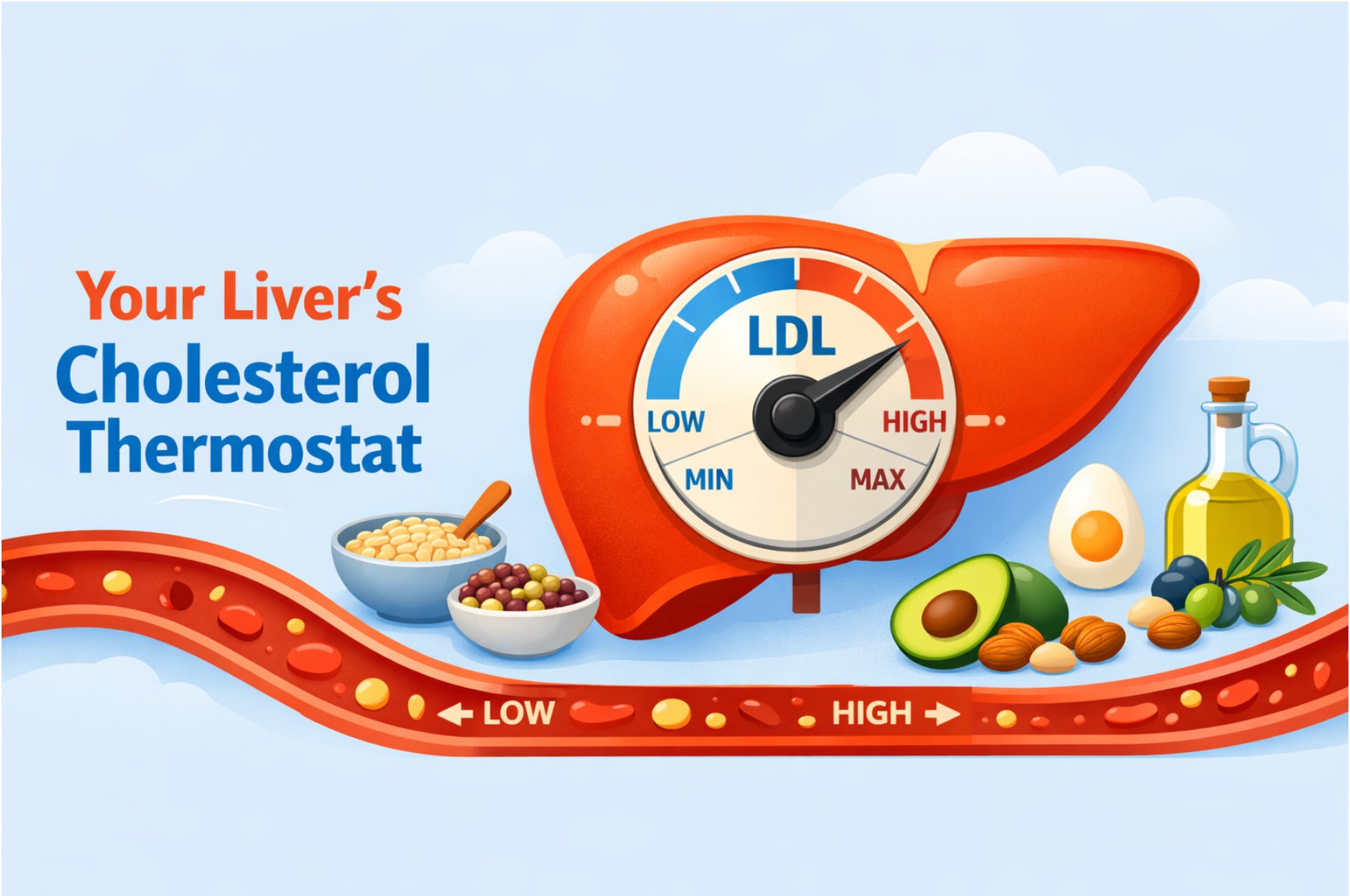
Did you know that most cholesterol in your body is made internally (endogenously), with the liver acting as the control center? Dietary cholesterol can contribute, but intestinal absorption varies widely between individuals. When dietary cholesterol is lower, the body can increase its own production to maintain supply. When dietary cholesterol is higher, the body can reduce production.
Harvard Health offers an example: at roughly 200–300 mg/day of dietary cholesterol, the liver may produce about 800–1000 mg/day to meet needs. Of course, exact numbers vary, but the idea is that your body buffers supply by adjusting production, absorption, uptake, and excretion.
What controls LDL in the bloodstream
LDL levels aren’t just about how much cholesterol you “make.” They’re strongly influenced by how efficiently LDL particles are cleared from the blood.
Inside cells, a regulatory pathway helps manage this balance. When cellular cholesterol is low, the body turns up cholesterol-making enzymes (including HMG-CoA reductase) and increases LDL-receptor activity to pull more LDL out of circulation. When cholesterol is plentiful, those signals are turned down.
Absorption: A transporter called NPC1L1 helps absorb cholesterol in the intestine and is the target of ezetimibe, a medication that lowers LDL by reducing absorption.
Excretion: Cholesterol leaves the body directly and via bile acids. Soluble fiber can help by binding bile acids in the gut, increasing loss in stool, which can prompt the body to use more cholesterol to replace them. The FDA has authorized health claims for certain soluble fibers (like oats and barley) in appropriate dietary patterns.
So what actually moves LDL the most?
If you’re trying to improve LDL, the biggest reliable levers are usually dietary pattern and fat quality—not simply “avoid cholesterol foods.”
Saturated fat quality often affects some individuals, and the Dietary Guidelines for Americans recommend keeping saturated fat under 10% of calories. Focus on consuming mostly olive oil, plain nuts, seeds, avocado, grass-fed butter, and real home-cooked whole meals. Whether or not you have high cholesterol, this is a healthier way to eat.
Soluble fiber and a plant-forward base like oats (beta-glucan), barley, beans/lentils, Himalayan tartary buckwheat, and psyllium can help remove and digest excess cholesterol in the body.
Consistent energy balance (especially for active people) and weight trends can influence lipids for many people, but aggressive restriction can backfire for training and recovery. Consistency is really the key. While adjusting your intake, use weekly averages as feedback.
What about eggs?
Eggs are one of the most nutrient-dense foods. Although they still have a bad reputation because they are high in cholesterol, context is important — how do you consume eggs? Are you frying them and adding bacon or eating them with fried rice? It’s not just eating eggs alone that might be the problem. Cooking eggs in a little bit of olive oil and adding fresh veggies, fresh fruits or berries with plain rolled oats and chia seeds or psyllium husk will give a very different meal.
People respond differently. Differences in absorption, LDL-receptor activity, and genetics can all change response. Our body’s role is to survive, so for this reason it’s hard to find balance in everything (homeostasis). Therefore, if you’re avoiding cholesterol entirely, your liver might work overtime to produce more cholesterol. So, as always, eating whole foods, getting enough fiber, protein, micronutrients, getting whole food sources of fat, not consuming fast food, consuming fish regularly and/or taking an omega-3 supplement, and maintaining slightly above adequate vitamin D levels can all help you live healthily and not worry about your cholesterol number too much.
References:
- Harvard Health Publishing. How it’s made: Cholesterol production in your body. Harvard Health Publishing. Accessed February 27, 2026. https://www.health.harvard.edu/heart-health/how-its-made-cholesterol-production-in-your-body
- Brown MS. Retrospective on cholesterol homeostasis: the central role of Scap. Proc Natl Acad Sci U S A. 2018;115(38):9468-9470. https://pmc.ncbi.nlm.nih.gov/articles/PMC5828883/
- Jo Y, DeBose-Boyd RA. Control of cholesterol synthesis through regulated ER-associated degradation of HMG-CoA reductase. Crit Rev Biochem Mol Biol. 2010;45(3):185-198. https://pmc.ncbi.nlm.nih.gov/articles/PMC2937355/
- American Heart Association. Saturated fat. American Heart Association. Accessed February 27, 2026. https://www.heart.org/en/healthy-living/healthy-eating/eat-smart/fats/saturated-fats
- Duan Y, Li F, Tan B, et al. Regulation of cholesterol homeostasis in health and diseases. Signal Transduct Target Ther. 2022;7(1):288. https://www.nature.com/articles/s41392-022-01125-5
- Betters JL, Yu L. NPC1L1 and cholesterol transport. Front Biosci. 2010;15:961-974. https://pmc.ncbi.nlm.nih.gov/articles/PMC2909875/
- Electronic Code of Federal Regulations (eCFR). 21 CFR 101.81 Health claims: Soluble fiber from certain foods and risk of coronary heart disease. Accessed February 27, 2026. https://www.ecfr.gov/current/title-21/chapter-I/subchapter-B/part-101/subpart-E/section-101.81
- US Department of Agriculture, US Department of Health and Human Services. Dietary Guidelines for Americans, 2020–2025. 9th ed. December 2020. https://www.dietaryguidelines.gov/sites/default/files/2020-12/DGA_2020-2025_ExecutiveSummary_English.pdf
- American Heart Association. Prevention and treatment of high cholesterol (hyperlipidemia). American Heart Association. Accessed February 27, 2026. https://www.heart.org/en/health-topics/cholesterol/prevention-and-treatment-of-high-cholesterol-hyperlipidemia
- American Heart Association. Here’s the latest on dietary cholesterol and how it fits in with a healthy diet. Published August 25, 2023. Accessed February 27, 2026. https://www.heart.org/en/news/2023/08/25/heres-the-latest-on-dietary-cholesterol-and-how-it-fits-in-with-a-healthy-diet
- Centers for Disease Control and Prevention. LDL and HDL cholesterol and triglycerides. Centers for Disease Control and Prevention. Accessed February 27, 2026. https://www.cdc.gov/cholesterol/about/ldl-and-hdl-cholesterol-and-triglycerides.html
- American Heart Association. What is familial hypercholesterolemia? American Heart Association. Accessed February 27, 2026. https://www.heart.org/en/health-topics/cholesterol/genetic-conditions/familial-hypercholesterolemia-fh
- Sayed A, et al. Distribution of apolipoprotein B levels across low-density lipoprotein cholesterol strata. JAMA Cardiol. 2024. https://jamanetwork.com/journals/jamacardiology/fullarticle/2820073
- Pencina KM, et al. Interplay of atherogenic particle number and particle size. J Am Heart Assoc. 2023. https://pmc.ncbi.nlm.nih.gov/articles/PMC10833272/
- Haffner SM, Mykkänen L, et al. A preponderance of small dense LDL particles is associated with insulin resistance and hypertriglyceridemia. Arterioscler Thromb Vasc Biol. 1995;15(12):1997-2003. https://pubmed.ncbi.nlm.nih.gov/8582543/
- Mykkänen L, et al. Relationship of LDL particle size to insulin sensitivity in normoglycemic men. Arterioscler Thromb Vasc Biol. 1997;17(7):1447-1453. https://pubmed.ncbi.nlm.nih.gov/9261279/
- Franczyk B, Gluba-Brzózka A, et al. The impact of aerobic exercise on HDL quantity and quality. Int J Mol Sci. 2023;24(9):7812. https://pmc.ncbi.nlm.nih.gov/articles/PMC10003711/