
Rewriting human limits? What Older Athletes Can Teach Us
Part 1 of 2
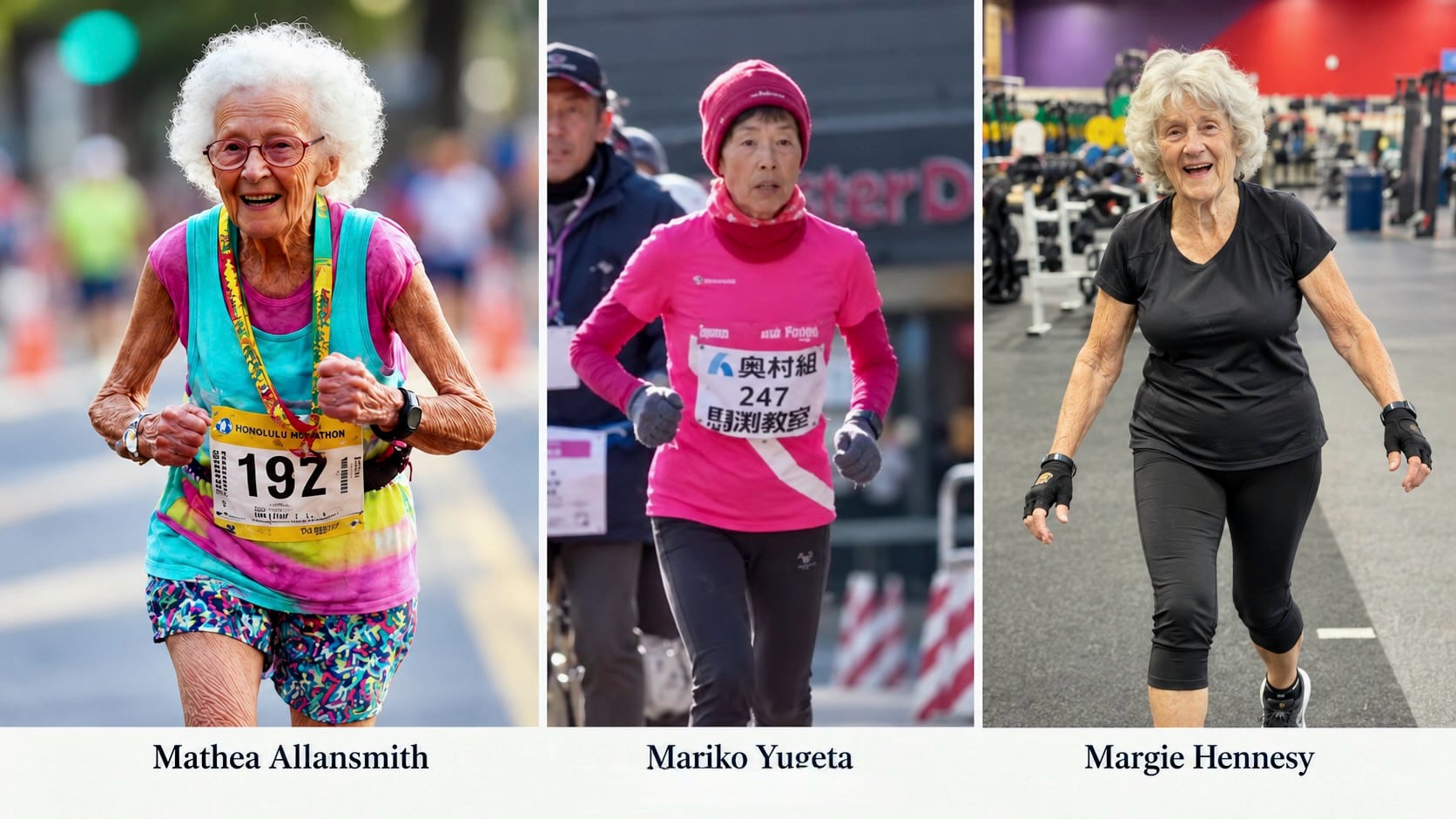
At 92, Mathea Allansmith had a marathon to finish.
On December 11, 2022, the Kōloa runner completed the Honolulu Marathon in 11 hours, 19 minutes and 49 seconds. Guinness World Records recognized her as the oldest woman to complete a marathon, at 92 years and 194 days.
That is an extraordinary achievement. What I find just as interesting is that Mathea took up running at 46, after a colleague suggested it. A decision made in midlife became something she was still enjoying decades later. I love that part of her story. It leaves room for all the people who are wondering whether they have waited too long to begin.
Of course, a marathon may hold absolutely no appeal for you. Perhaps you would love to keep hiking, work comfortably in your garden, or travel without worrying about every flight of stairs. Those goals are just as important.
Then there is Margie Hennesy. At 90, she is preparing for her first HYROX event, a competition combining running and exercise stations. In her first-person account in Women’s Health, she describes beginning consistent gym training with support from her daughter-in-law, Becky. Margie had already spent years walking and doing physical work around her home. Formal training was a new chapter in an active life. The family encouragement in her story is wonderful: someone saw what she might enjoy trying, and helped her get started.
Japanese runner Mariko Yugeta is another remarkable example. At 62, she ran the 2021 Osaka International Women’s Marathon in the amazing time of 2h 52min. Unlike Margie, she had a long running background.
When we see people doing extraordinary things later in life, it is tempting to explain everything with one word: genetics. It is certainly true that genetics contributes to differences between people. But these stories cannot tell us how much a particular gene contributed to anyone’s achievement. Years of activity, health, training, recovery and support are all relevant. A sports DNA test cannot reliably tell us who will become an exceptional athlete.
We also have evidence beyond remarkable individual stories. In a study published in 2024, researchers followed 12 healthy adults over 85, whose average age was 87, through 12 weeks of resistance training. They gained muscle and improved strength and physical performance. The study was small, and its healthy volunteers do not represent every older adult. Still, it offers encouraging evidence that the capacity to respond to training can remain well into later life.
That is useful information for someone who is hesitating to start.
As a coach, I want us to make room for the quieter achievements too. Being able to get out of a chair more comfortably or carry the shopping with greater confidence can make a real difference to someone’s day. Those are goals worth working toward.
I also want people to feel welcome in this conversation when their bodies are hurting, when illness has interrupted their plans, or when exercise has never felt like something they belong in. Someone else’s finish line does not tell us where your starting line should be. It is your own health and experience that should guide that decision.
So perhaps the first question is simply this: what would you like your body to help you do?
Be specific. Think about a place you would love to visit, an activity you miss, or something ordinary you would like to find easier. That gives movement a purpose you can picture.
Then consider one manageable step toward it. Perhaps it is arranging a walk with a friend or asking a coach to help you begin strength training. If pain, illness or balance difficulties are getting in the way, a clinician or physical therapist can help you work out an appropriate starting point.
And tell someone about your goal. Having a walking partner or someone expecting you at class can make getting started feel more welcoming.
In part two of this column, I will look at how to build a realistic routine, recognize progress and gradually adjust exercises as they become easier.
For now, I keep coming back to the question behind these stories: What would you love to still be doing at 80 or 90?
Whatever your answer, it deserves a little space in your life today.
Sources
1 Mathea Allansmith’s marathon record
Guinness World Records. Official record entry: age, date and finish time.
2 Mathea’s running background
Guinness World Records, August 2, 2023. Kōloa connection and starting running at 46.
3 Margie Hennesy’s first-person account
Women’s Health, October 12, 2026.
4 Mariko Yugeta’s performance and background
World Athletics athlete profile and Nippon.com interview, March 22, 2022.
World Athletics profile | Nippon.com interview
5 Resistance training in adults over 85
Marzuca-Nassr GN et al. International Journal of Sport Nutrition and Exercise Metabolism. 2024;34:11–19. DOI: 10.1123/ijsnem.2023-0087. The study included 12 healthy adults over 85 and a comparison group of 17 adults aged 65–75.
Study abstract and publication details
6 Genetics and athletic prediction
Australian Institute of Sport. Position statement on genetic testing in sport.